
ANNUNCIATION
Calling, courage, and consent

Today is the Feast of the Annunciation – the moment when an Angel announced to Mary that she was to be the mother of the Lord. The story is often read in Advent, in anticipation of celebrating the nativity at Christmas, but March 25th (exactly 9 months before Christmas) is the official feast day. In a very rare case, Easter could occur before March 25th, but most years the Feast of the Annuciation falls during Lent. So, although it is a welcome break from Lenten solemnities, it is worth considering how the story speaks within the Lenten journey. And as it is a story about listening to God, it seems to me that it does speak to our understanding of God’s call to us, both individually, and as communities.
The Annunciation has traditionally been interpreted with deep reverence towards Mary as God’s willing servant, establishing her as the model of the ‘ideal’ Christian woman. But for a long, long time that ‘ideal’ has been overlaid with the idea of a woman who always subjugates herself and obeys God without making a fuss. (As the ever popular Basque carol has it,
‘Then gentle Mary meekly bowed her head,
“to me be as it pleaseth God,” she said’
Over time, though, the idea of Mary’s obedience to God transferred itself into the problematic notion that the ideal Christian woman simply subjugates herself to, and obeys . . . well, anyone who demands it.
Now, there are multiple examples of women in theological settings who have NOT fitted that mould. I’m thinking of Hadewijch in the 13th century, Julian of Norwich in the 14th, Jesse Penn Lewis in the 19th, and plenty more. But since the 1960s, theologians have asked more pointedly: what kind of God would demand unquestioning obedience of Mary, or of any woman, or of anyone at all? That question came into even sharper focus in 2017 with the sudden rise of the #MeToo campaign, when women in churches, theology departments and Divinity schools dared to frame the question even more bluntly: ‘was God’s treatment of Mary just one more instance of coercion or force?’ The question, then, is not simply one of curiosity about Mary’s situation, but a vital theological question about the nature of God: that is to say, what kind of God is revealed in the story of the annunciation? This question that has been answered in various ways by professional theologians, but some of the most interesting answers have come from artists, sculptors and poets – stay with me, and we can explore a few of them.
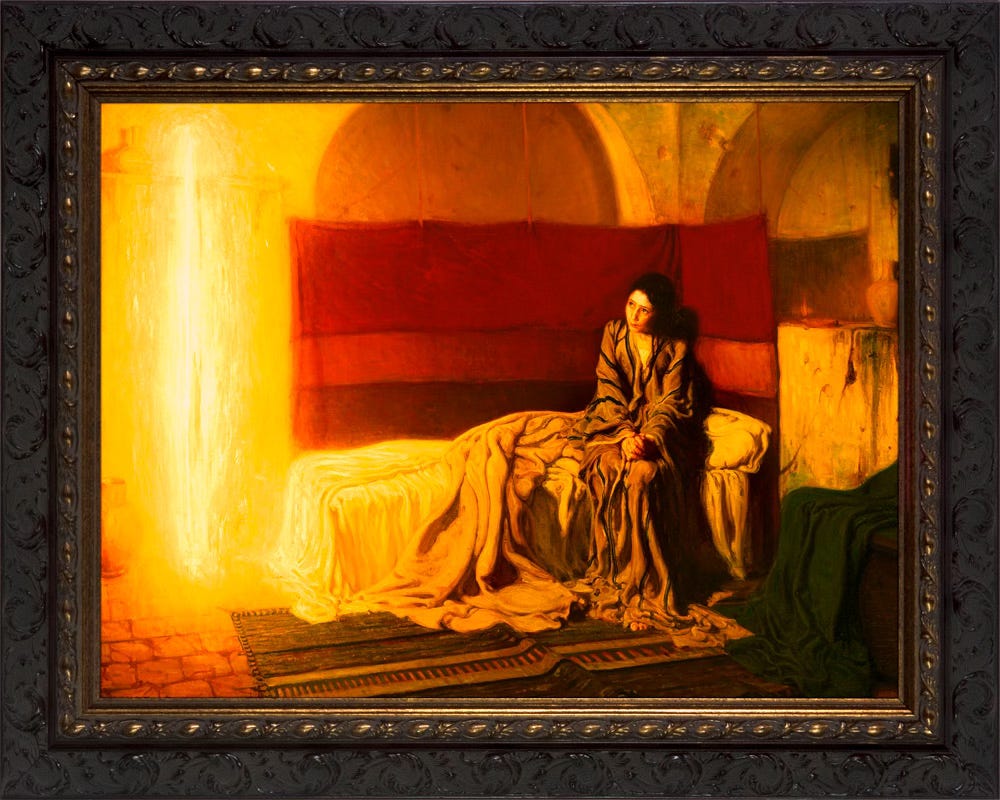
Henry Ossawa Tanner: The Annunciation (1898)
First, here’s Luke’s account:
In the sixth month, the angel Gabriel was sent by God to a town in Galilee called Nazareth, to a virgin engaged to a man named Joseph, of the house of David.
The virgin’s name was Mary. The angel came to her and said, “Greetings, favored one! The Lord is with you.” But she was much perplexed by his words and pondered what sort of greeting this might be. The angel said to her, “Do not be afraid, Mary, for you have found favor with God. And now, you will conceive in your womb and bear a son, and you will name him Jesus. He will be great, and will be called the Son of the Most High, and the Lord God will give to him the throne of his ancestor David. He will reign over the house of Jacob forever, and of his kingdom there will be no end.” Mary said to the angel, “How can this be, since I am a virgin?”
The angel said to her, “The Holy Spirit will come upon you, and the power of the Most High will overshadow you; therefore the child to be born will be holy; he will be called Son of God. And now, your relative Elizabeth in her old age has also conceived a son; and this is the sixth month for her who was said to be barren. For nothing will be impossible with God.” Then Mary said, “Here am I, the servant of the Lord; let it be with me according to your word.” Then the angel departed from her. Luke 1:26-38
The first thing to notice is that Luke did not name this “Annunciation” – or “announcement” – but simply says Gabriel was sent by God. But many Bibles have that heading added at the top of the paragraph, which could be taken to suggest that Mary is simply being told, without any consultation with her at all, what is going to happen to her.
The second thing to notice is that angels – who feature regularly in the Biblical narratives – are sometimes described as fantastic, luminous, winged creatures, but at other times they simply appear in human form. BUT . . . think about this:
At the end of Mark’s gospel, when the women went to the tomb and found it empty, there was a figure there who told them Jesus was risen . . . but Mark just says it was a “young man”. And there was a moment in Abraham’s story when three men came past his encampment; he invited them in for dinner, then he walked with them on the next part of their journey, and it wasn’t until he had spent the whole day with them that he realised he was talking with the Lord himself! So supernatural visitations are not always huge, or scary, or even very obvious.
Although Luke doesn’t actually tell us what Gabriel looked like, the winged version is somehow always assumed, probably because nearly all paintings of the annunciation show him clearly as a supernatural being with huge wings – some more scary than others! But another version of the Annunciation sits alongside the gospel accounts. It’s not in the Bible, but it is of a similar age to many of the New Testament writings: The Protoevangelium of James, which was supposedly written by James, brother of Jesus. And although it is broadly similar to Luke’s account, there is one significantly different feature concerning the appearance of the Angel, which is that when Mary first became aware of the Angel’s presence, the angel was not visible at all. She heard a voice, but she looked all around – to the right and the left – and there was no one to be seen. Only when SHE engaged in the conversation did the angel materialize and become visible to her. Now, the experience was still overwhelming, but the fact that the Angel did not appear until she spoke up is suggestive of her agency in this encounter. She could have ignored him, and he would have gone away. But because she was interested, the conversation began.
Noel Rowe, who was a priest and poet, took up this idea of the angel first as a mere presence in the room, waiting for Mary to say she wants to know more, before the offer is made. Rowe paints a picture, not of Mary being bamboozled into saying ‘Yes’, but of an angel waiting until Mary is ready and willing to give consent:
The angel did not draw attention to himself.
He came in. So quietly I could hearmy blood beating on the shore of absolute
beauty. There was fear, yes, but alsofaith among familiar things:
light, just letting go the wooden chair,the breeze, at the doorway, waiting to come in
where, at the table, I prepared a meal,my knife cutting through the hard skin
of vegetable, hitting wood, and the noiseoutside of children playing with their dog,
throwing him a bone. Then all these soundsdropped out of hearing. The breeze
drew back, let silence come in first,and my heart, my heart, was wanting him,
reaching out, and taking hold of smooth-muscled fire.And it was done. I heard the children laugh
and saw the dog catch the scarred bone.
Noel Rowe: Magnificat (i)
Denise Levertov is another poet who ponders the idea of consent – but she also pushes the idea back out to the reader: this is not just Mary’s choice, but yours too! The first part of the poem states unequivocally that Mary simply MUST have had a choice—for this is basic to humanness, and God as the creator could not or would not violate her humanity. So Levertov writes:
. . . we are told of meek obedience. No one mentions
courage.
The engendering Spirit
did not enter her without consent.
God waited.She was free
to accept or to refuse, choice
integral to humanness.
But then Levertov turns the story around, first of all, to say that you – the reader – know how this feels, because you, too, have stood in front of possible options in your life, and made a choice. The choice between saying YES to an opportunity, or letting it pass you by. The choice between risking a daring, unknown path, or settling for the safe option. Levertov puts her finger on the reality that when we have choices to make in life, it is extremely rare that we can summon up options we want to consider, and then choose one. It’s almost always the case that we choose between taking an opportunity that is put in front of us, or staying where we are. Do it, or don’t – knowing that if you DO, you can’t go back, and if you DON’T, you might be safer, but you’ll never know what would have happened if . . . . And – most difficult of all, there may not necessarily be a ‘right answer’. It really is a choice. And we really have to make it.
Levertov writes:
Aren’t there annunciations
of one sort or another
in most lives?Some unwillingly
undertake great destinies,
enact them in sullen pride,
uncomprehending.More often
those moments
when roads of light and storm
open from darkness in a man or woman,
are turned away from
in dread, in a wave of weakness, in despair
and with relief.Ordinary lives continue.
God does not smite them.
But the gates close, the pathway vanishes.
Levertov stresses, then, that Mary was not forced, but also that, rather than merely being willingly acquiescent, she was courageous!
This poses the idea that it would actually have been easier for Mary NOT to have to make a choice. But she did, and – though she might have been well advised to say no, she had the courage to say ‘yes’ – a choice made not merely for herself, but for the world.
These poets are not re-writing the story! Right there in Luke’s gospel, if you simply read on to the end of the Chapter, you see Mary’s courage and agency in The Magnificat, which shows you Mary not as a clueless teenager staring open-mouthed and not knowing what’s happening, but as a young woman who knows what’s going on, and is fully engaged in being a part of it!
Mary was called by God, invited, had to make a decision, and was courageous enough to say YES! What about us? I can think of times in my life when I said YES to a risky option, and it was clearly a ‘calling’ — not a bed of roses, but endlessly worthwhile, and something I will always be glad I said Yes to. (For the record, I can think of one time when I said YES and later wished I hadn’t!) But I can think of another time when I was offered what I now see was a fantastic opportunity and – at the time – really didn’t grasp what I was being offered, and said NO! And – qua Levertov – God did not smite me. But there is no going back. We have agency in responding to God’s call to take part in His kingdom.
May God help us to listen, to understand, to have the courage to say “yes”. May God help us to forgive ourselves for the times we said “no” and regretted it. And to have the courage and the serenity to listen, all over again.