
Bad Friday

‘Why is it called Good Friday?’ asked my son, when he was seven years old. Tears ran down his face. ‘It’s not good at all, it’s really, really bad.’ Reading the story in his children’s Bible, he was deeply upset at the plight of ‘poor Jesus’.
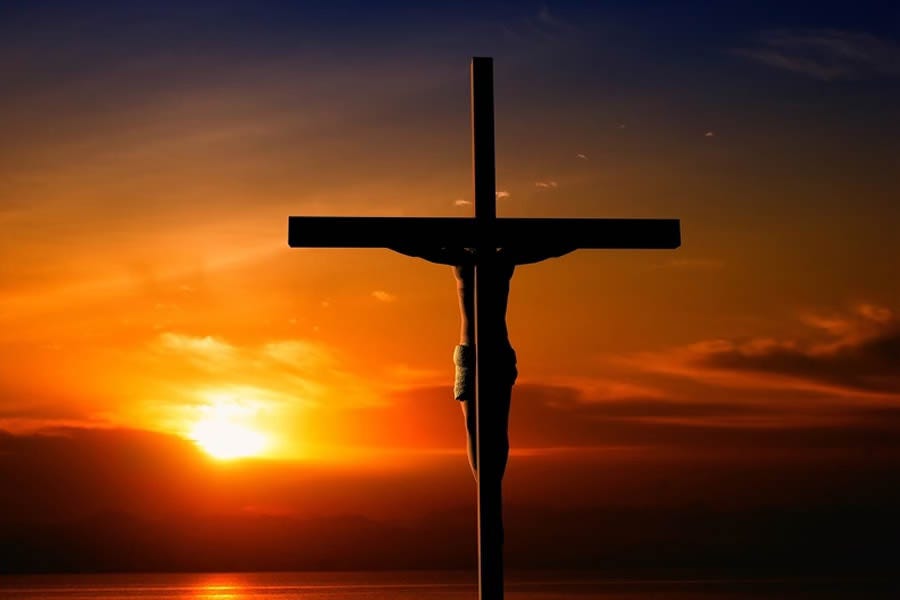
For those of us, who know the end of the story, there can be a temptation to move swiftly over the agonising picture of Jesus’ death, and reassure ourselves with the foreknowledge of the happy ending. But the impact of Good Friday is snatched away if we rush too quickly to the promise of resurrection. We might want to dwell for a moment on the dreadful spectre of Good Friday, and all the ripples that go out from it – not only its meaning in terms of our spiritual salvation, but its connection to the injustices of the world, the suffering of innocents, the evil of regimes that keep tight control over people’s lives and end up destroying them, body and soul. It is also true that we can lessen the outrageous, unimaginable joy of Easter Sunday if we dampen it down by immediately reminding ourselves of the cross. There is a time for everything – a time to laugh and a time to weep, a time for joy and a time for sadness – and we miss something if we do not allow ourselves to be met by each chapter of the story as it unfolds.
Today we remember Jesus’ suffering and death by crucifixion. He stood for life and love, justice and faith. He upset convention and exposed hypocrisy until the world could stand it no longer, and tried to stamp him out. The early Christian writers saw this death as God’s trick against the devil: the devil wanted him dead, but failed to understand that the Son of God cannot remain dead for long – not unlike the ‘deep magic’ and the ‘magic deeper still’ of which C.S. Lewis wrote in The Lion, the Witch and the Wardrobe.9
It is important to realize, however, that the disciples (and, to a certain extent, Jesus himself) could not see beyond the moment. Retrospectively, the whole event was overlaid with layers of theological meaning, which were gradually crystallized in the gospels in written form. John’s account emphasizes Jesus’ victory over death so strongly that Jesus seems to be in control, almost floating above the impact of the suffering. Matthew makes connections with Messianic prophecies and theological meaning, while Luke pays close attention to the impact of the crucifixion on other people. Of the four gospel writers, Mark is the one who best conveys a sense of the sheer human suffering and agony of the cross.
There are similar differences of interpretation in depictions of the cross in art. In the early centuries of Christianity, the cross was never used as a symbol of Christianity, precisely because it was an instrument of torture as well as a means of execution. Crucifixion was such an agonising and humiliating death that it was not used for citizens of the Roman Empire, except for traitors, and eventually it was banned altogether because it was so barbaric. Later, depictions of the cross became central to religious art, but representations were largely symbolic. Take a trip round any Western art gallery and you will find medieval paintings of a clean, white Jesus hanging from a cross, with a scratch or two on his otherwise perfect body. The portrayal of the ugly reality of crucifixion entered the world of religious art only quite recently.
One of the most heart-rending images of the cross is The Tortured Christ by Brazilian sculptor Guido Rocha. The beaten and battered body of Jesus hangs from the cross with every sinew stretched against pain, and his face contorted in screams of agony and rage, which not only vividly portrays Jesus’ own suffering but also deliberately links the cross with the sufferings of religious or political prisoners who are being tortured to death at this very moment.

Like Mark’s stark telling of the story, Rocha’s sculpture produces a sense of horror and revulsion by focusing on Jesus’ human experience there and then, rather than reflecting on its theological meaning after the event. Images such as this are a shocking reminder that true Christianity is not comfortable, conventional, or respectable. It is a faith that demands radical commitment, will cost at least some kind of sacrifice, and may even cause degrees of pain. Is that the kind of faith we are prepared to take on?
Jesus endured real, vile torture to the point of death. As we remember his agony, let us also pray with compassion, and act with courage on behalf of those who are victims of torture somewhere in the world today. When we look at religious imagery like this, something is lacking if we say in our prayers that we long to take Jesus down from the cross and end his suffering, but fail to do the same for those suffering today. That is not just a ‘social gospel’; it is the call of Jesus himself, when he said:
‘I was hungry, and you gave Me something to eat; I was thirsty, and you gave Me something to drink; I was a stranger, and you invited Me in; naked, and you clothed Me; I was sick, and you visited Me; I was in prison, and you came to Me… Truly I say to you, to the extent that you did it to one of these brothers of Mine, even to the least of them, you did it to Me.’ (Matthew 25:35–36, 40, NASB)
Thank you for this. I remember you writing something about personally being out of sync with the seasons of the year. I’m currently in another line of treatment and have found Holy Week deeply engaging and moving, thinking often of WH Vanstone’s writings. At the Anglican Church we now are part of, the foot-washing, Eucharist and The Watch only intensified my experience, and we’ve not yet been to the Good Friday service! Although with St Augustine at tomorrow’s Vigil I will rejoice that we are an Easter People I’m not there yet and strongly identify with Mark’s Gospel. Undergoing the Ignatian Spiritual Exercises gave me a sense, particularly in Mark,that the resurrection was a penny dropping, but slowly. Please excuse the long response - my excuse is steroids! With all good wishes.