Doing nothing for God.
(The Parable of the Sower, revisited)


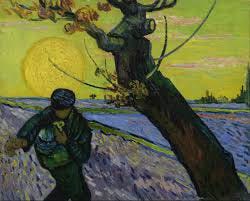
Jesus went out of the house and sat beside the sea. Such great crowds gathered around him that he got into a boat and sat there, while the whole crowd stood on the beach. And he told them many things in parables, saying: “Listen! A sower went out to sow. And as he sowed, some seeds fell on the path, and the birds came and ate them up. Other seeds fell on rocky ground, where they did not have much soil, and they sprang up quickly, since they had no depth of soil. But when the sun rose, they were scorched; and since they had no root, they withered away. Other seeds fell among thorns, and the thorns grew up and choked them. Other seeds fell on good soil and brought forth grain, some a hundredfold, some sixty, some thirty. Let anyone with ears listen!” Matthew 13: 1-9
The Parable of the Sower is one of the best known of Jesus’ stories. But the thing with stories we know really well is that we think we know what they mean. And this one . . . well, it’s so often interpreted as if it’s a story about how to have success, and how to avoid failure, that it’s difficult to imagine it’s anything other than that. I’ve heard it applied to personal growth – as if you need to make sure that YOU are “good soil” for God’s work –– and deal with those things in your life that are choking out what’s good. And I’ve heard it applied to achievements in life and work and ministry – whatever you do with your time and your talents, make sure that you don’t waste it! don’t throw your resources into places where they get eaten up and disappear. I think these interpretations occur partly because, when we read this story, we only start paying attention at the SECOND verse – “A sower went out to sow”.
But let me suggest that the key to understanding the parable is actually the very first verse: “Jesus went out and sat beside the sea”.
Almost everywhere else in the gospels, we read that Jesus went up a mountain to pray, or stopped along the way to do a few healings, or changed his plans to go perform a miracle. And it’s so easy to overlook the fact that in this one single verse, Jesus went out . . . and sat beside the sea. What? no praying? no teaching? no miracles? Hmmm. Apparently not. Apparently, he goes off-grid, turns off his phone, doesn’t take a book to read... he just sits, watching the waves lapping on the beach, and does absolutely NOTHING. (When was the last time you did that?)
Then some people came by. “Jesus!” they said, “since you’re obviously not busy -- tell us some of your stories! Do us a miracle! change the world, brighten up our day . . .” (or something like that). So he pushes out in a boat, and using the water as a natural amphitheatre, he tells them this story about a farmer, sowing seeds.
Now, in the first century, if you were sowing seeds in a field to grow a whole bunch of wheat, or barley, or something, this is how it was done: you’d carry a basket of seeds on your hip, and walk through the field throwing out seeds in every direction. There simply wasn’t enough time to pick your way neatly down the edge of the field, ensuring that every seed fell in just the right place. There were no mechanical ploughs, or drilling machines, and everyone knew that when you sowed seeds, some of them would inevitably get wasted. Some would land on open spaces, and the birds would eat them. I guess you could say that at least you were feeding the birds! But nothing was gonna grow right there. Some would land around the edges of the field, where there were so many weeds to compete with that even if they grew, they would never be harvested. MOST of the seeds would land in the field, and – MOST years, weather permitting, MOST of them would produce at least something. But even then, the farmer couldn’t control what happened next – would the harvest be a fantastic 100% of what was sown? Or a moderate 60%? Or perhaps just 30%, which would be minimal and a bit disappointing, but better than nothing at all. But here’s the thing: the outcome didn’t depend on the farmer’s skill or commitment or work ethic, it depended on the soil, and the weather – all of which were beyond your control.
Once again, picture this: what was Jesus actually doing right before he told this story? -- he was doing NOTHING! And then he tells a story about how, no matter what you do, some things are beyond your control. So I don’t think he was trying to say, ‘work smarter! work harder! Prove yourself!’ – rather, I think he was pointing out that regardless of what we do, some of life’s outcomes are in the luck of the draw, or in the turn of the tides. Perhaps he was not even interested in coaching us get 100%, but instead trying to liberate us from the constant pressure to achieve.
If you’re anything like me, you might sometimes look back on your life thus far, and wonder whether you could have done better. (What more could I have done, if only I had not started out with this or that disadvantage; if only I had pursued an opportunity instead of letting it pass me by; if only I had not been held back by sexism, or some other “ism”; if only I had made this decision instead of that one; if only that bereavement/ redundancy/ illness/ pandemic, or some other thing had not pulled the rug from under my feet?) Perhaps, like many people, you read the parable of the sower and think, “OK, Jesus, but I don’t want to be a 30 per-cent-er. 60 might be just about acceptable. But what I really want is to be 100%.” We all have different reasons for feeling that way – personal ambition, or the pressure of someone else’s expectations, or the anxiety that your work will all go to waste. Or maybe – together with any of those reasons – you just want to be sure your life has counted for something.
We live in a world where everything is measured in numbers, from school grades, to the size of your home, to the salary attached to your work. We have been conditioned to think that 100 must be better than 60, and 30 sounds pretty disappointing. But I think that completely misses the point of the parable of the sower. I don’t think Jesus was talking about how to ensure you get a high score, or that your work is a success, or, – perhaps even worse – how not to be mediocre. I don’t think it’s about that at all. I think he was pointing out that a great deal of life is simply about throwing yourself out there, and seeing what happens. Some of what you do will come to nothing; that’s just the way it is. Some of it might start to grow, but get choked out by other things. Some of it will do OK – not remarkable, just OK. But – just once in a while – something will reallywork out, and will come out shining.
The fact that Jesus uses an agricultural metaphor is significant, because the success rate of agriculture is beyond anyone’s control, and it doesn’t always follow that the greatest skill and the hardest work produces the results. I think the point of the parable is that you can’t control the outcomes.
It’s a pretty common human tendency to look back and wondering about the way our lives have unfolded. But let’s not waste time thinking about how we could have done it better. Rather than a recipe for success, or a coaching session to try harder, and produce better outcomes, I think the parable is a reality check – an encouragement to do your best day’s work while the day is here, but to recognize that when your day’s work is done, some of it will grow, and some of it will not. How much gets wasted, how much grows a little bit, and how much grows exponentially is really beyond your control. It’s not your fault if it doesn’t grow. It’s just the way the world is.
But meantime, it’s OK to go and sit beside the sea.
To stare at the waves lapping in and out.
To stop fretting about what’s going to happen next.
To relax in the knowledge that you are enough.
And – just for a little while – to do absolutely nothing.